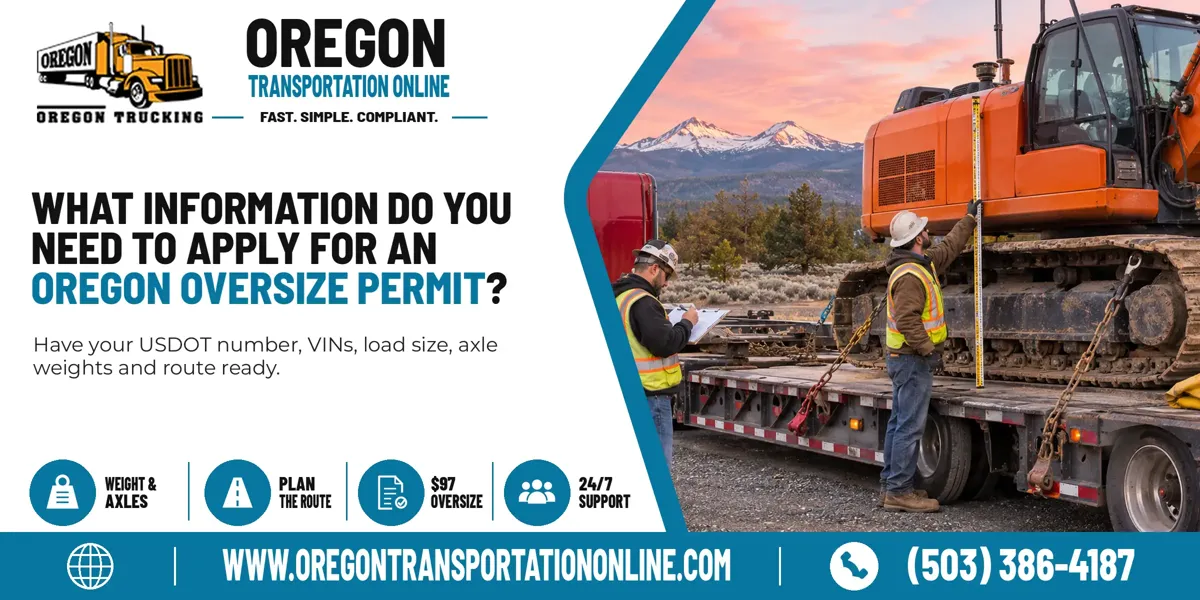
What Information Do You Need to Apply for an Oregon Oversize Permit?
Table Of Contents
-
Introduction
-
The Short Answer
-
Carrier Information
-
Truck and Trailer Information
-
Load Description
-
Dimensions and Weights
-
Axle Weights and Axle Spacing
-
Route and Travel Dates
-
Pilot Vehicles and Special Conditions
-
Information Checklist
-
Common Mistakes to Avoid
-
Why Many Trucking Companies Choose Our Service
-
FAQ
Introduction
Most delays with an Oregon Oversize Permit don't come from the permit office. They come from missing or wrong information in the application. A missing axle weight, a wrong VIN or a guessed height can hold up the permit or make it invalid at the scale.
This guide lists the information you need before you apply for an Oregon Oversize Permit, so the application goes through the first time and the load moves on schedule.
The Short Answer
To apply for an Oregon Oversize Permit, have this information ready:
-
Carrier details: USDOT number, legal business name and contact information
-
Truck and trailer details: VINs, plates, make, year and number of axles
-
Load description: what the load is, with make, model and serial number
-
Dimensions: width, height, length and front and rear overhang
-
Weights: gross weight, each axle weight and axle spacing
-
Route: origin, destination and the roads the load will use
-
Travel date: when the move will start
Oregon's over-dimension rules are in OAR 734-082, and permits are issued by the Oregon Department of Transportation (ODOT) Commerce and Compliance Division.
Carrier Information
The permit is issued to the carrier responsible for the move. You'll need:
-
USDOT number
-
Legal business name and any DBA name
-
Mailing address, phone and email
-
Contact person who can answer questions about the load
If the truck is leased, use the carrier that has control of the truck during the trip. The name on the permit should match the name on the truck and the shipping papers.
Truck and Trailer Information
The permit lists the exact vehicles used for the move. Have these details for the truck and every trailer:
-
VIN
-
License plate number and the state or province that issued it
-
Make and year
-
Number of axles on each unit
-
Registered weight, if needed for the weight-mile tax
Copy VINs and plate numbers straight from the registration. A single wrong digit can make the permit fail to match the truck at a weigh station.
Load Description
ODOT needs to know what you're hauling and whether it can be made smaller.
-
Type of load, such as an excavator, transformer, beam or modular building
-
Make, model and serial number for machinery
-
Number of pieces on the trailer
Most oversize permits are for non-divisible loads, meaning loads that can't be taken apart without great effort, cost or damage. If parts can be removed to bring the load under the limits, such as a bucket or counterweight, ODOT may expect that to be done.
Dimensions and Weights
Measure the load on the trailer, ready to move. These are the numbers the permit needs:
| Measurement | Oregon Legal Limit | What to Measure |
|---|---|---|
| Width | 8 feet 6 inches | Widest point, including tracks or attachments |
| Height | 14 feet | Road surface to the highest point |
| Semitrailer length | 53 feet | Overall length of truck, trailer and load |
| Overhang | Varies | How far the load sticks out front and rear |
| Gross weight | 80,000 pounds | Truck, trailer and load together |
Round up, never down. A load that turns out taller or wider than the permit says may not be covered.
Axle Weights and Axle Spacing
Weight isn't just about the total. Oregon looks at how the weight sits on the road.
-
Each axle weight and axle group weight
-
Distance between axles, measured center to center
-
Tire size and the number of tires per axle
Heavy loads are checked against bridges and pavement on the route. Correct axle spacing can make the difference between an easy approval and a route change.
Route and Travel Dates
The Oregon Oversize Permit lists the exact roads the load may use. You'll need:
-
Origin and destination addresses
-
Highways the load will travel, such as I-5, I-84 or US-97
-
County roads or city streets at the start or end of the trip
-
Planned start date
Plan the route around low bridges, tight turns and construction zones. Very large loads, such as those over 14 feet wide on two-lane state highways, are treated as superloads and need more lead time.
Pilot Vehicles and Special Conditions
ODOT sets pilot vehicle needs from the load size and the highway, using Route Map 2 and the Pilot Car Guide. Have this ready if the load may need them:
-
Pilot vehicle company or operator names
-
Certification for pilot vehicle operators
-
Certified flaggers, if the move must stop traffic
The permit comes with attachments, such as Attachment H for travel times, so read them before the move.
Information Checklist
-
USDOT number, business name and contact details.
-
VINs, plates, make, year and axles for the truck and each trailer.
-
Load type, make, model and serial number.
-
Width, height, length and overhang, measured on the trailer.
-
Gross weight, axle weights, axle spacing and tire sizes.
-
Origin, destination, route and county roads.
-
Planned start date and pilot vehicle details, if needed.
Common Mistakes to Avoid
-
Guessing measurements. Measure the loaded trailer every time.
-
Leaving out overhang. Front and rear overhang can change the permit.
-
Typos in VINs or plates. The permit must match the truck.
-
Missing county roads. Every road on the trip must be on the permit.
-
Applying too late. Superloads and complex routes need more time.
Why Many Trucking Companies Choose Our Service
Oregon Transportation Online checks your truck, load and route details before the application goes in, so your Oregon Oversize Permit is right the first time and the load moves on schedule.
-
Oversize permit: $97
-
Trip permit: $105
-
Temporary weight-mile pass: $50 plus weight-mile tax
We provide support 24/7 and also work weekends and holidays.
or
FAQ
What information do I need for an Oregon Oversize Permit?
Your USDOT number, truck and trailer details, load description, dimensions, weights, axle spacing, route and travel date.
Do I need axle weights?
Yes. Oregon checks each axle and axle group, not just the gross weight.
Should I measure the load on the trailer?
Yes. Height is measured from the road to the highest point of the loaded trailer.
Do county roads need to be on the permit?
Yes. Every road the load uses must be listed.
What is the legal width in Oregon?
8 feet 6 inches.
For more information, visit the Oregon Department of Transportation.