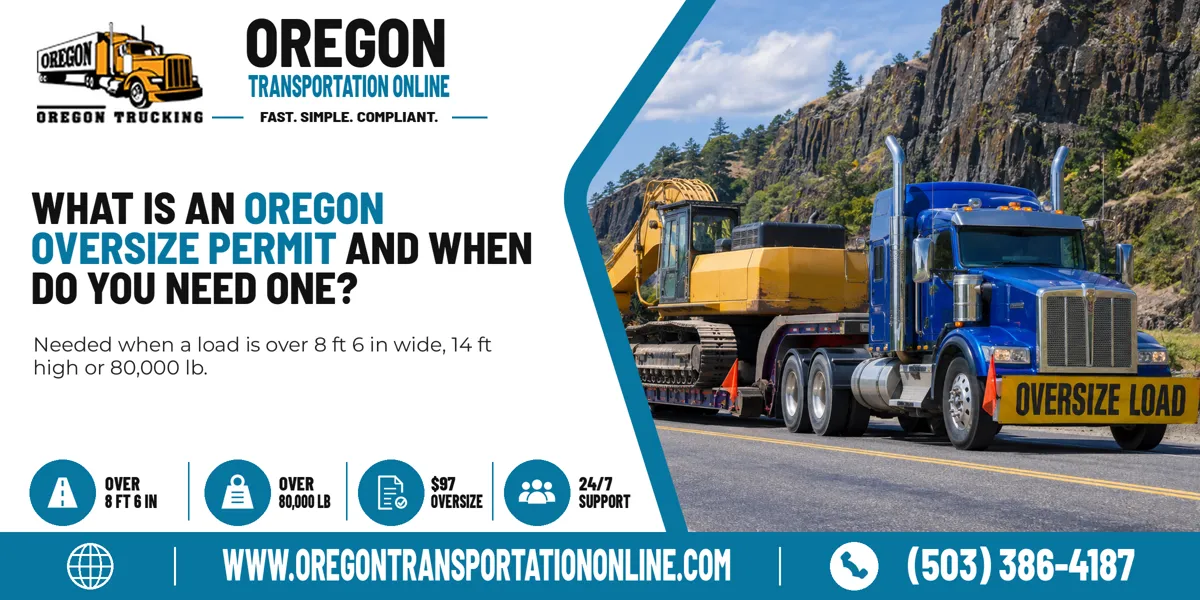
What Is an Oregon Oversize Permit and When Do You Need One?
Table Of Contents
-
Introduction
-
The Short Answer
-
What an Oregon Oversize Permit Is
-
When You Need One
-
Single-Trip and Annual Permits
-
Pilot Vehicles and Superloads
-
Signs, Flags and Lights
-
Travel Times and Routes
-
How to Get an Oregon Oversize Permit
-
Common Mistakes to Avoid
-
Why Many Trucking Companies Choose Our Service
-
FAQ
Introduction
Excavators, wind tower sections, modular homes and big farm machines all move across Oregon every week. Most of them are too wide, too tall or too long for normal road limits.
To move a load like that legally, you need an Oregon Oversize Permit. This guide explains what the permit is, when you need one, the main permit types, and what the permit asks of the driver on the road.
The Short Answer
An Oregon Oversize Permit is a variance permit from the Oregon Department of Transportation (ODOT) that lets a vehicle or load run on Oregon highways beyond the legal size or weight limits.
You need one when your load is wider than 8 feet 6 inches, taller than 14 feet, longer than the legal length for your combination, or heavier than the legal weight. The permit sets your route, travel times, and any pilot vehicle, sign or light requirements.
What an Oregon Oversize Permit Is
Oregon's size and weight limits are set in ORS Chapter 818. When a load can't meet those limits, ODOT can issue a variance permit that allows the move under set conditions. ODOT's over-dimension rules are in OAR Chapter 734, Division 82.
The permit is not just permission to be big. It's a set of instructions. It lists:
-
The route the load may use,
-
The dimensions and weight allowed,
-
Travel time limits, such as daylight-only moves,
-
Pilot vehicle and traffic control needs, and
-
Attachments the driver must follow and carry.
When You Need One
You need an Oregon Oversize Permit when the vehicle or load goes over any legal limit:
-
Width over 8 feet 6 inches.
-
Height over 14 feet.
-
Length over the legal limit for your combination, such as a semitrailer longer than 53 feet, or a load that overhangs too far.
-
Weight over the legal gross or axle limits, generally 80,000 pounds gross.
The load should also be non-divisible. That means it can't be broken down into smaller loads without unreasonable cost or damage. A pile of lumber that could go on two trucks usually won't qualify.
What it means for you: measure the load on the trailer, not just the trailer. A machine that sticks out 4 inches on each side makes the whole load over-width.
Single-Trip and Annual Permits
ODOT offers two main kinds of permits:
-
Single-trip permit. Covers one move, on one route, for one load. It fits one-off moves, such as delivering a single excavator.
-
Annual permit. Covers repeated moves within set limits for a year. ODOT lists annual types such as Extended Weight, Non-Divisible, Long Logs/Poles/Piling and Mobile/Modular Unit.
Both can include county roads, and ODOT notes that only annual permits are available for Portland city streets.
What it means for you: if you haul the same kind of load into Oregon often, an annual permit can save time and money.
Pilot Vehicles and Superloads
Oregon decides pilot vehicle needs by the load's width, height, length or overhang and the highway it uses. The permit tells you how many pilot cars you need.
Very large loads are superloads and get extra review. These include loads:
-
Over 16 feet wide on Interstate and multi-lane highways,
-
Over 14 feet wide on two-lane state highways,
-
Over 17 feet high, or
-
Longer than 150 feet.
Superload moves may need certified flaggers, and some routes use a rolling stop with three certified pilot vehicles.
Signs, Flags and Lights
Under OAR 734-082-0037, an over-width or over-length vehicle must display "OVERSIZE LOAD" signs to the front and rear. The outer edges of an over-width load must be marked in daylight with red flags at least 18 inches square.
Under OAR 734-082-0036, an over-width load needs warning lights when it's over 10 feet wide on a two-lane highway or over 12 feet wide on a four-lane highway.
Travel Times and Routes
Under OAR 734-082-0021, travel times follow Attachment H, which comes with the permit. It explains daylight, night, weekend and holiday limits for your load.
Stay on the route printed on the permit. A wrong turn onto a road that isn't listed can mean a citation, even if the load fits there.
How to Get an Oregon Oversize Permit
Have this information ready before you apply:
-
Your USDOT number and business details.
-
The truck and trailer information, including plates and axles.
-
The load description, such as make and model.
-
The overall width, height, length and overhang.
-
The gross weight and axle weights.
-
The origin, destination and travel date.
Oregon Transportation Online prepares the application and sends the permit by email or text, so the driver has it before the move.
Common Mistakes to Avoid
-
Measuring the trailer, not the load. The widest point counts.
-
Leaving the permitted route. The permit covers only the listed roads.
-
Skipping Attachment H. It sets your travel times.
-
Using a single-trip permit for Portland. Only annual permits work there.
-
Forgetting signs and flags. They're required on over-width loads.
Why Many Trucking Companies Choose Our Service
Oregon Transportation Online helps carriers get the right Oregon Oversize Permit with the right route and conditions, so the load moves without delays.
-
Oversize permit: $97
-
Trip permit: $105
-
Temporary weight-mile pass: $50 plus weight-mile tax
We provide support 24/7 and also work weekends and holidays.
or
FAQ
What is an Oregon Oversize Permit?
It's an ODOT variance permit that lets a vehicle or load exceed Oregon's legal size or weight limits under set conditions.
How wide can a load be without a permit in Oregon?
Up to 8 feet 6 inches. Anything wider needs a permit.
How tall can a load be without a permit?
Up to 14 feet.
Do I need a pilot car?
It depends on the load's size and the highway. The permit lists the requirement.
Can a single-trip permit cover Portland city streets?
No. Only annual permits are available for Portland city streets.
For more information, visit the Oregon Department of Transportation.